Latest Medieval Book Research

Medieval Swearing, “God’s Bones!”
There are trends and fashions in swearing. Things that were outrageous and blasphemous in one age might raise nothing but a curious stare in the 21st century.

It’s difficult today to understand why swearing by parts of God’s body would be offensive, but it was a popular way of swearing up to the end of the 15th century. People would swear by “God’s Nails” or “God’s Bones”, “God’s Teeth”, even “God’s Balls!”

It a tough concept to get your head around, but I’ll try to explain it as best I understand it myself. So, to the medieval mind swearing an oath was a deadly serious affair. If you swore a sincere oath you were asking (even forcing) God in heaven to look down and guarantee what you said was in fact true. In an age where religion was an integral part of daily life, if you swore a false oath you were in effect making God out to be a liar!  In addition, to swear by parts of God’s body you were literally thought to be affecting those parts of his body up in heaven. These words and phrases have a power that is mostly lost on us today, but you would use them when you trapped your finger in a door, insulted someone, even expressed joy and amazement.

On the other hand, some words and phrases which were part of everyday speech in the medieval ages would today, in polite company at least, raise eyebrows. Describing bodily functions wasn’t a big deal, and it was normal practice for something like a street name to reflect the street’s function or the economic activity taking place within it. Which explains streets in many medieval towns called Gropecuntlane, Oxford and London to name just two. You can image what went on there. The local stream might well be called the Shitebrook for similar reasons….

I confess I find this sort of stuff fascinating. It might not be your cup of tea, but if you are interested, there’s a brilliant book about the history of swearing, “Holy Sh*t” by Melissa Mohr. It’s available on amazon.

My favourite writers of medieval fiction – No1 – Ellis Peters – The Cadfael Chronicles

I’ve always been a fan of historical fiction, although over the years I’ve also read a lot of science fiction. Still, I always seem to return to books set in the past, particularly the medieval period. It seems a lifetime ago (and I suppose it really is now) when I first came across The Cadfael Chronicles (a series of historical murder mysteries written by Edith Pargeter under the pen name “Ellis Peters”). The first book, A Morbid Taste for Bones,  was published in the late 70s and I would guess I began reading the series in my early teens (I was a strange kid!). They feature the Benedictine monk Cadfael (of Shrewsbury Abbey) who aids the local forces of law and order in solving murders. The books were made into a very popular TV series here in the UK shown during the mid-90’s, it was also shown in the US.

Partgeter died in 1995, but I think we can credit her with being one of the authors who first really popularised what became the historical mystery genre. The books are beautifully written and might be a bit tame for some readers (I’ve seen them recently tucked under the Cosy Mystery sub-genre) but I for one always enjoyed the gentle unfolding of each story. There are twenty-one books in the series, so something to get your teeth into and highly recommended.

The English Medieval Penny

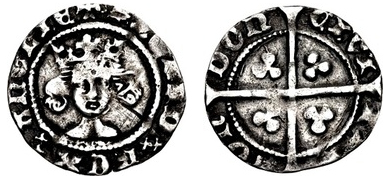
The most widespread coin in use in medieval England was the penny. Twelve silver pennies made a shilling and there were twenty shillings to the pound. For transactions worth less than a penny it could be divided by physically clipping the coin into halves and quarters. Hence, half pennies and quarter pennies (known as farthings). Although official half pennies and farthings existed, they don’t ever seem to have been issued in the quantities needed to stop them being anything but rarities. The clipped coins therefore being the norm for anything less than a whole penny.

In accounting the Silver mark was used, although no actual mark coins existed. One mark was equal to 13 shillings and 4 pennies, which was two-thirds of one pound.

Wages and buying power in medieval England are notoriously difficult to estimate from a modern vantage point. There are so many unknowable factors at play that everything you can find on the subject can only ever be an estimate of what things cost on a daily basis.

I’ve assumed some typical daily earnings for the lower ranks of society for the time period my books are set in (1390’s – 1420’s) which I think are fairly accurate. A labourer, manservant, maidservant or swineherd might earn between one and three pennies a day. More skilled craftsmen like masons, carpenters, thatchers and weavers might earn between three and six pennies a day. A chantry priests might earn four pennies a day and an esquire or constable in the army perhaps thirteen pennies a day.

Cheap wine was about three pennies a gallon, the good stuff perhaps eight pennies a gallon. Ale, the staple drink of everyone, was three quarters of a penny for a weak gallon of ale and one and half pennies for a gallon of a better brew. Two dozen eggs could be had for a penny and you could buy two chickens for three pennies.

Medieval English Ale

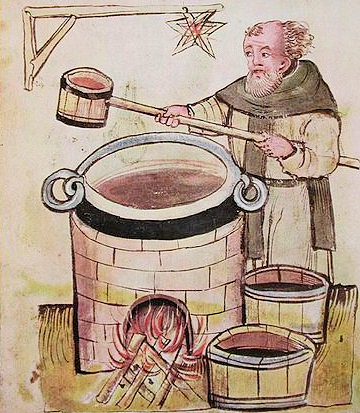
In medieval England virtually everyone would have drunk ale on a daily basis. That’s not to imply that the whole population was constantly inebriated. The fact is medieval ale was a very different drink to any modern-day beer or ale. The basic ingredients were water and malted grain fermented with yeast (beer as oppose to ale also included hops as an ingredient). Ale was both used for hydration and nutrition and was very much an essential part of the English diet. This was a time when most people rarely drank water or milk. Although the wealthier could also afford to drink wine, ale was the overwhelming liquid refreshment of choice for much of the population. Then as now people could drink to get merry, to get drunk even, but it was also a much more mundane, day to day experience. Both children and adults drank ale, it was consumed throughout the day.

The basic ale making process consisted of the malted grain being crushed, boiling or very hot water would be added, and the mixture allowed to work. The liquid would then be drained off, cooled and fermented.

Although a relatively simple process it was also time consuming. In medieval England this type of ale would be served fresh which means it had very recently stopped fermenting or it was still in the process of fermenting. Ale did not keep well, being fast to sour and lasting at most only a few days.

The amount of ale that was brewed and consumed appears enormous to modern day eyes. For a household of five perhaps up to one and quarter gallons would be required per day.

During the fourteenth century most of the ale brewing in England was carried out by women in a domestic setting. Most households had the capability to brew ale for their own use and sometimes to sell to others. For many households it could be a valuable source of extra income even if they only sold to others a few times a year. When a fresh brew was available for others to buy a sign would be hung outside, often a broom.

The Medieval Revenant

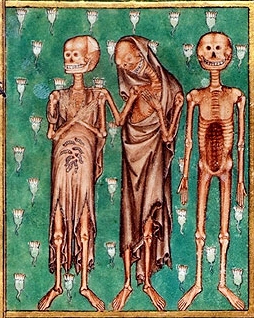
During the middle ages a belief in souls returning from the dead was very common. A revenant was an animated corpse believed to have been revived from the dead to haunt the living. At various times the term revenant has often been used interchangeably with vampire. Numerous contemporary writers of the period recount stories relating to these undead souls.

Perhaps the most well know is William of Newburgh (or Newbury) (lived 1136 – 1198 in England). He recorded that such stories were common “were I to write down all the instances of this kind which I have ascertained to have befallen in our times, the undertaking would be beyond measure laborious and troublesome!” This didn’t however stop him later recounting such stories with some ghoulish satisfaction.

He continues, “It would not be easy to believe that the corpses of the dead should sally (I know not by what agency) from their graves, and should wander about to the terror or destruction of the living, and again return to the tomb, which of its own accord spontaneously opened to receive them, did not frequent examples, occurring in our own times, suffice to establish this fact, to the truth of which there is abundant testimony.”

It seems William was a believer at least as far as he didn’t discount out of hand the stories he came across. To the medieval mind it seems it was a perfectly possible scenario to have the recently departed wandering around the countryside terrifying the living.

One story involves a man who becomes jealous of his wife. Trying to catch her up to no good he hides in the bedroom rafters. Unfortunately, he manages to fall from his hiding place, seriously injuring himself in the process and dies a few days later. This is where things take a sinister turn.

“By the handiwork of Satan, from his grave at night-time, and pursued by a pack of dogs with horrible barkings, he wandered through the courts and around the houses while all men made fast their doors, and did not dare to go abroad on any errand whatever from the beginning of the night until the sunrise, for fear of meeting and being beaten black and blue by this vagrant monster.”

The monster then goes on a rampage and kills several of the townsfolk before they take action to counter the horror.

“Thereupon snatching up a spade of but indifferent sharpness of edge, and hastening to the cemetery, they began to dig; and whilst they were thinking that they would have to dig to a greater depth, they suddenly, before much of the earth had been removed, laid bare the corpse, swollen to an enormous corpulence, with its countenance beyond measure turgid and suffused with blood; while the napkin in which it had been wrapped appeared nearly torn to pieces. The young men, however, spurred on by wrath, feared not, and inflicted a wound upon the senseless carcass, out of which incontinently flowed such a stream of blood, that it might have been taken for a leech filled with the blood of many persons. Then, dragging it beyond the village, they speedily constructed a funeral pile; and upon one of them saying that the pestilential body would not burn unless its heart were torn out, the other laid open its side by repeated blows of the blunted spade, and, thrusting in his hand, dragged out the accursed heart. This being torn piecemeal, and the body now consigned to the flames.”

A tale which surely wouldn’t disgrace a modern horror film.

In the 12th Century the chronicler Walter Map records a similar tale of a “wicked man” of Herefordshire who comes back from the dead. He takes great pleasure in wondering the streets of his village during the night-time calling out the names of those who will die of a sickness. Naturally his fellow villagers are less than impressed. They enlist the help of the bishop of Hereford who authorises them to dig up the body and cut of its head with a spade. He sprinkles it with holy water and re-inters it in the hopes it will desist its nightly rambles.


Medieval Anchorites


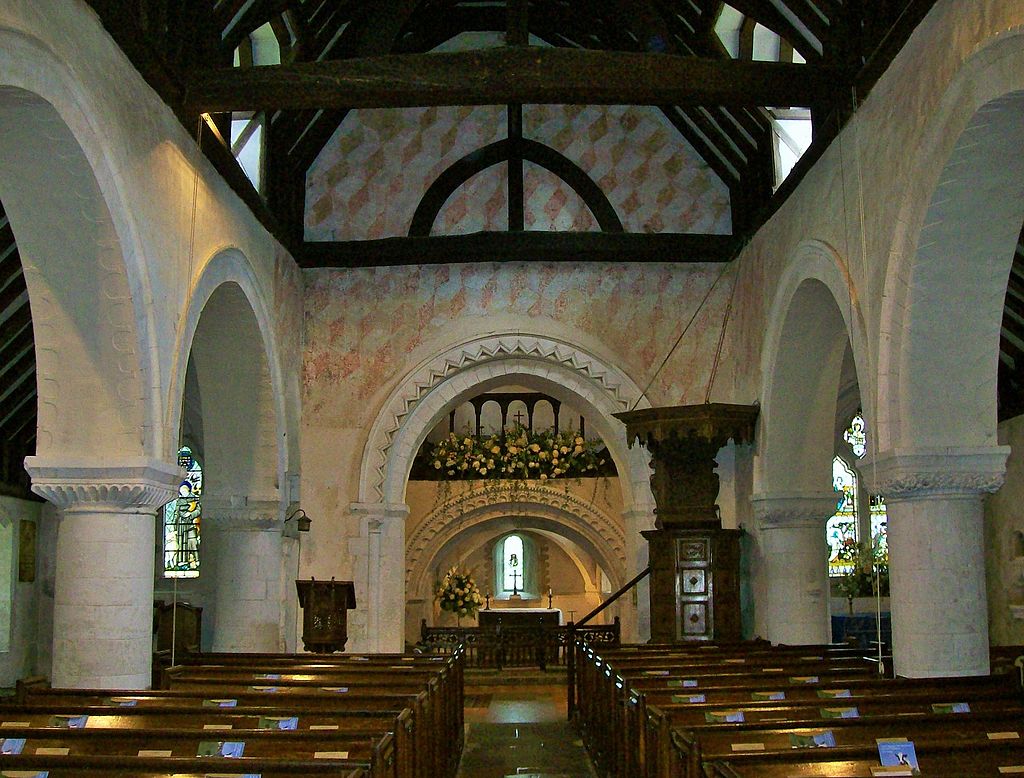
In the third of the William Blackburne series of medieval adventures a spate of killings involving anchorites takes place. Many people confuse the terms anchorite and hermit. Although anchorites can be thought of as religious hermits there were some subtle differences. Most were required to take vows that tied them to one place. Many opted for permanent enclosure in cells attached to churches. Looking from a modern perspective it’s difficult to comprehend the attractions of being walled up for life in a small cell! Anchorites became widespread during the 13th and 14th centuries and in England it was not at all unusual for the local village church to have an anchorite cell built against one wall. The majority of anchorites, at least during the later middle ages, appear to have been female.

On becoming an anchorite, they were subject to a religious rite similar to that of a funeral. They became in effect dead to the world and often considered living saints. The typical size of the enclosure (cell) was 3.7 to 4.6 m (12 to 15 ft) square. Usually there were some small windows, one facing the outside for light, the others opening to the interior of the church. The anchorite could hear mass and receive communion via a shuttered window know as a squint. They could also provide counsel and spiritual advice through this window to visitors. Many anchorites gained a great reputation for wisdom over the years of their enclosure. One of the other interior openings would allow food and other items to be passed in and waste removed (A chamber pot being provided for bodily waste!)

Not every anchorite was confined to a cell. Some did have access to the church itself although their vows would probably exclude them from leaving the main building. The vows were for life and those who broke them and escaped or attempted to escape would be returned by force.To break their vows would also be to damn their soul to hell.

Perhaps the most famous English anchorite of the middle ages was Julian (or Juliana) of Norwich, also known as Dame Julian or Mother Julian. She wrote the earliest surviving book in the English language to be written by a woman, Revelations of Divine Love

Medieval Shipping – The Cog

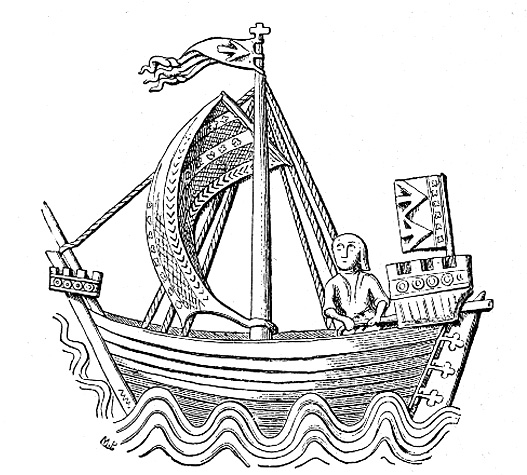
An image of Medieval Cog

In my book “Death of the Vintner” the three bishop’s officials of the story arrive at the small harbour town of Tenby in the west of Wales by sea. The ship they travel in was known as a Cog. This type of ship first appeared in the 10th century and was in use across Northern Europe from the 12th century onward. The vessels had a single mast with a square-rigged sail. They were clinker built, usually of oak and ranged in size roughly from fifteen to twenty-five meters in length with a beam between five and eight meters. Some of the largest cogs could easily carry 200 tons.

The cog developed into a sturdy seagoing trader, that was capable of crossing even the most dangerous passages. For defence against Pirates fore and stern castles would be added. The stern castle allowed more cargo space below by keeping the crew and the tiller up out of the way. The cog had reached its full potential by the 14th century and other forms of ship design started to be explored but the cog continued in widespread use for several centuries in one form or another.

The Population of the English Medieval City

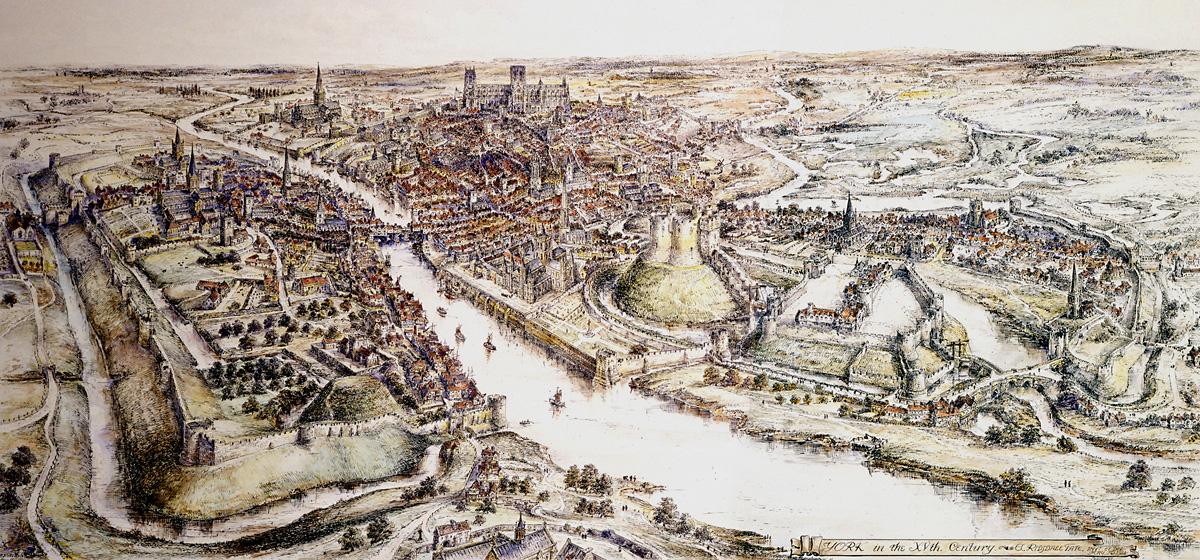
An image of Medieval York
In 1377 of the thirty most populous cities and towns in England only three had a population of more than ten thousand people. These were London with forty thousand, York (see picture above) with twelve thousand and Bristol with ten and a half thousand. The others ranged in size from Coventry at eight thousand down to Nottingham and Winchester with two thousand four hundred each.

The whole of the county totalled around two and a half million people. Only a hundred or so years before the population had been almost double this but the Black Death had decimated numbers. Compared to the great cities of continental Europe only London was of similar size. Only twelve percent of the population lived in a town of some kind. This is profoundly different than modern England where some eighty percent live in a town or city.

This isn’t to say that England’s medieval towns and cities were quiet places, far from it.
During the daytime the population of these places could almost double with people from the surrounding rural areas coming to sell their wares and others coming to buy. The inns added to the shifting population, there were travellers of all sorts making use of the accommodation they offered. The towns were vibrant and noisy places.

Medieval Violence

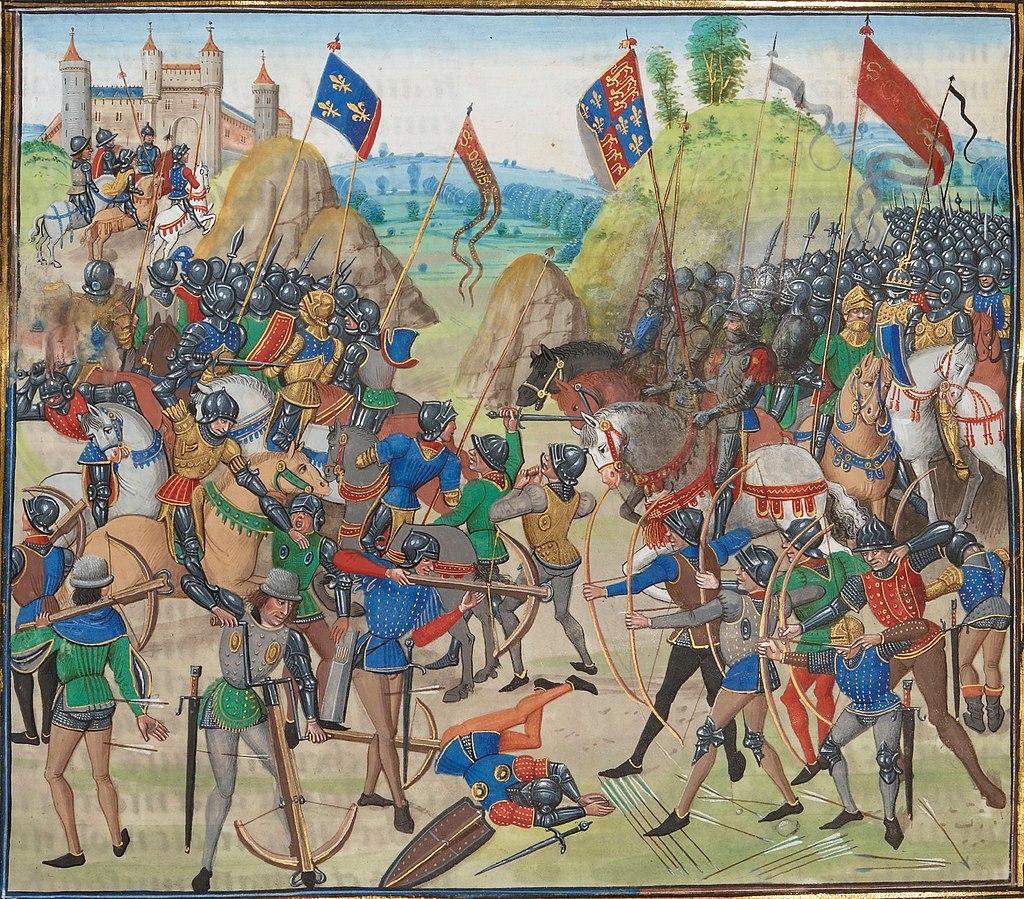
An image of a Medieval Battle
The middle ages in England were a pretty violent place viewed from a modern perspective. Even today statistically most crime is carried out by males on males under the age of 25.  A study of coroners rolls from the 1340’s suggests a homicide rate of 120 per 100,000 of the population in Oxford. That’s incredibly high when compared to around 1 in 100,000 today. Some of the worst cities for crime in the modern world only score around 111 per 100,000.

Medieval England was predominately a young society. The average age of death was around 35, that’s skewed of course by the childhood mortality rate which was most probably as high as 25% for those under 5 years. However, the young could and did hold significant roles in authority at ages that would raise modern eyebrows.

Access to the law particularly for those in the lower levels of society could be limited. Seeking revenge because the courts were non-existent, weak of simply untrustworthy was common. It seems some disputes could be more readily settled by doing violence to each other. And willingness to fight was often deemed an appropriate way of dealing with any sort of slight. Alcohol fuelled fights as today were very common. It must be remembered that people daily drank what would be considered today excessive quantities of ale. Even though rather weak by modern standards ale was preferred over the polluted water supplies of the medieval town.

As perpetrators, victims or simply witnesses, people from the lowest to the highest ranks of medieval society experienced violence as an ever-present part of daily life.

Medieval Seals

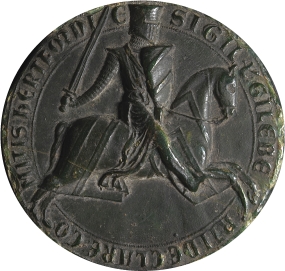
Image of The Seal Of William Blackburne Bishop's OfficialImage of the Seal of Gilbert de Clare, earl of Gloucester and Hertford

I’ve had a few questions about the medieval seal depicted on my upcoming book, “Death of The Official”. The image on the left depicts the impression made by William Blackburne’s seal matrix. William is an official of the bishop of Draychester and the Latin inscription reflects this.

The status of the seals owner was often reflected in the actual size of the seal. In medieval religious hierarchy no one would be allowed to own a seal as grand as one issued by their own superiors! The cheaper seal matrices would be made of lead whilst wealthier owners would own a seal matrix made from bronze. The bronze seal matrices were harder wearing and therefore lasted longer. Lead is a fairly soft metal and seal matrices made of this material often broke.

In the middle ages the majority of seals were circular in design but ovals, triangles, shield-shapes and other patterns are not unknown. Generally, the design would comprise some sort of graphic emblem often incorporating a heraldic device. Surrounding this would be a text (known as the legend). Often this would just consist of something like “The seal of the [Name of Owner]”. At this time the seals of women and priests and other members of the clergy would be given a pointed oval shape (a vesical). The emblem would be a standing figure of the owner or in the case of clerical seals that of a saint. The medieval towns-person would sometimes use a seal with images relating to their trade but a variety of different emblems could be used.

Medieval Bridge Chapels and Bridge Hermits

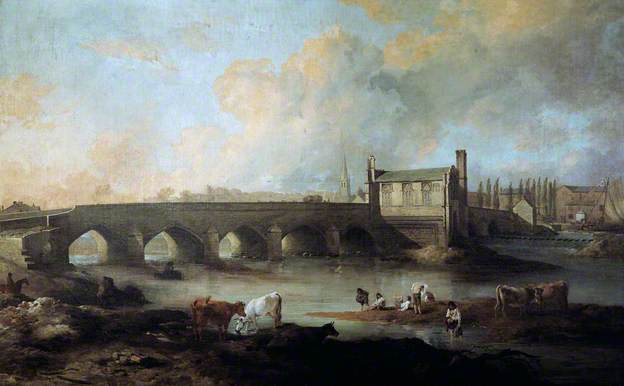
An image of the bridge chapel at Wakefield
In one of my upcoming books “The Death of the Official” Sir Roger Mudstone has an unfortunate encounter with a hermit collecting a toll on a bridge crossing a river. In the late medieval period it was fairly common for bridges to have all manor of buildings built on them. Perhaps one of the most common were chantry chapels. These were where prayers could be said for the souls of the founders and benefactors of the bridge. Donations were often collected for the upkeep of the structure. Bridge maintenance could be an expensive and ongoing task. However, to the medieval mind bridges with chapels could be thought of as less likely to collapse as the dedication of the chapel, often to a local saint or perhaps Saint Mary herself would offer some protection to the rest of the structure.

They were also a place for travellers and pilgrims to pray for a safe journey and attend mass. To the medieval pilgrim the bridge played a key role in a journey where the alternatives were dangerous ford and ferry crossings.

There are few medieval chapels associated with bridges that survive in England. Two important examples can be found in the West Riding of Yorkshire at Wakefield (see picture above) and at Rotherham. There are other significant chapels at Rochester and at Bradford Upon Avon.  In the aftermath of the Protestant Reformation many chapels were destroyed or fell into disuse and were eventually demolished. Some that did survive found new purpose as storage, offices and even gaols or shelters for livestock.

Most chapels would have a resident priest who said Mass for the travellers and pilgrims. He would often also live in the chapel. As travel could be dangerous in the medieval period the priest would often also be expected to say prayers for those injured, robbed or killed on the roads.
Another common presence at medieval bridges would be a hermit who would assist in the maintenance of the bridge and sometimes collect tolls. Occasionally hermits would be specifically granted alms for use in building small bridges.

Medieval Sanctuary

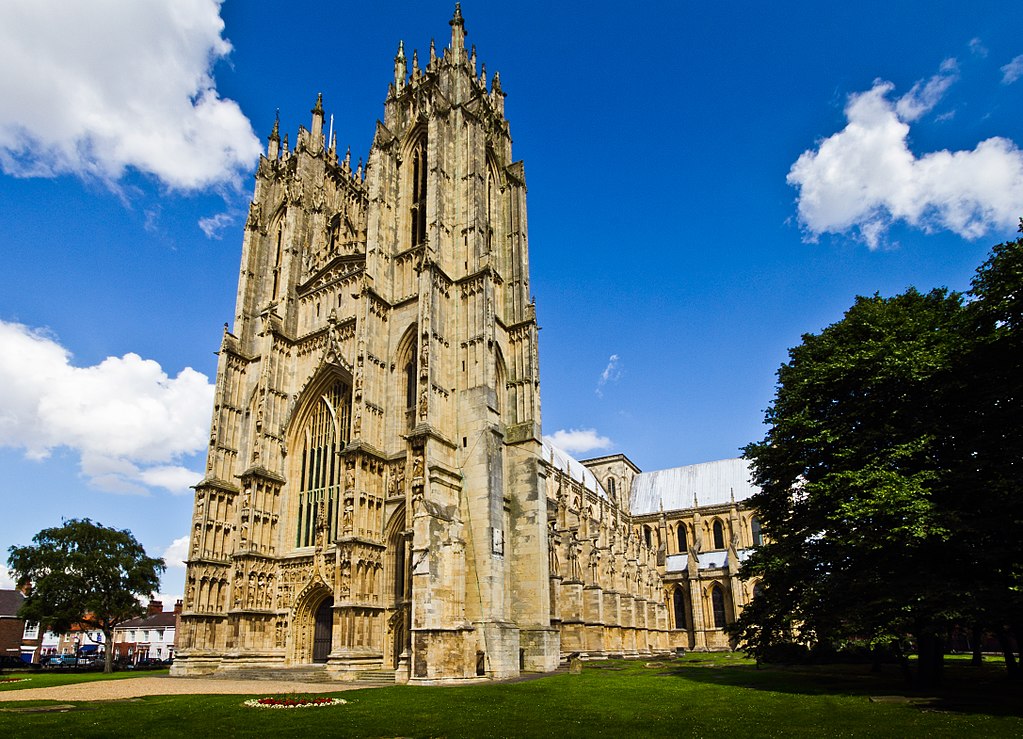
An image of Beverley Minster

In my upcoming book, “The Death of the Vintner”, two brothers sought for the murder of their father seek sanctuary in the cathedral at Saint Davids in West Wales. This was a crime that would likely result in execution. The alternative sought by many who committed capital crimes was to seek the protection of sanctuary in a Christian Church.

The right to sanctuary has its origins in ancient Greek and Roman times and survived in at least some form into the 17th Century. The belief system that gods were inviolable led to a tradition that their holy places were untouchable and thus a place where fugitives could escape the authorities. There was a price to pay for this shelter in terms of atonement and penance for the crimes committed. Medieval sanctuary had its foundations in these ancient beliefs.

By the late medieval period an almost standardised sanctuary process had emerged in England. On committing a crime, the sanctuary seeker would often flee to a nearby church. Church sanctuaries were regulated by common law. On entering the church he’d inform whoever was responsible that he intended to claim sanctuary. The fugitive then needed to confess their sins, surrender any weapons, and permit supervision by the church or abbey organization which had jurisdiction. A period of forty days sanctuary would then be granted. As long as they stayed within defined boundaries usually within the church building itself but sometimes over a wider area they could not be removed. It was illegal for the victim’s friends or relatives or the secular authorities to remove them and there were heavy penalties for those that tied.

The forty days was to allow the suspect to make a choice. Either stand trial according to law or confess their guilt and agree to abjure the realm. Which meant swearing an oath to effectively go into exile. The person taking the oath swore to leave the country directly and promptly, never to return to the kingdom unless by permission of the sovereign.

If the suspect decided to abjure the realm the coroner for that area, an official of the crown, would eventually be called. The suspect would confess their guilt to the crime usually in some form of public ceremony and the corner would then choose a port from where the fugitive would have to leave the kingdom from. Any possessions would be forfeit to the church and any land they owned to the crown. At least they would avoid execution but this was no soft option. They had to set out barefooted and bareheaded carrying a wooden cross-staff to indicate they were under the protection of the church.

At this point in theory they would take the main highway to the nearest port and leave safely. For any fugitive there were some unpalatable truths around what usually happened in practice. They could start out on their trek and once away from sight, jettison the cross and simply try and disappear and start a new life. The victim’s friends and relatives would have no illusions about the process and could simply follow them and administer vigilante justice at some point along the way. In theory the fugitive had only to leave the main highway and it would be perfectly legal for them to do this. It also seems that in some cases coroners would deliberately pick a port at the other end of the country. This would make it extremely difficult to fulfil the terms of the fugitive’s oath to adjure the realm.

There was always the chance of escape from sanctuary before the forty days were up, or simply the choice of sitting in the church past the time limit. However, many fugitives would be starved of food and water by the church authorities if they decided to simply sit and wait.

All churches had the power to grant sanctuary within the building, however there were some places where the bounds of the sanctuary area were much wider. These places had a specific royal charter to extend sanctuary to a wide zone around the church. Some of these areas extended to nearly a mile and a half from the church or abbey and the boundaries were marked by sanctuary crosses of stone. In England the churches with these areas included, York Minster and Westminster Abbey, the cathedrals at Wells and Winchester, Ripon, Norwich and Durham, Hexham Abbey, Battle Abbey and Beverley Minster (pictured above).

Copyright 2026, M J Westerbone. All rights reserved.